 WordVale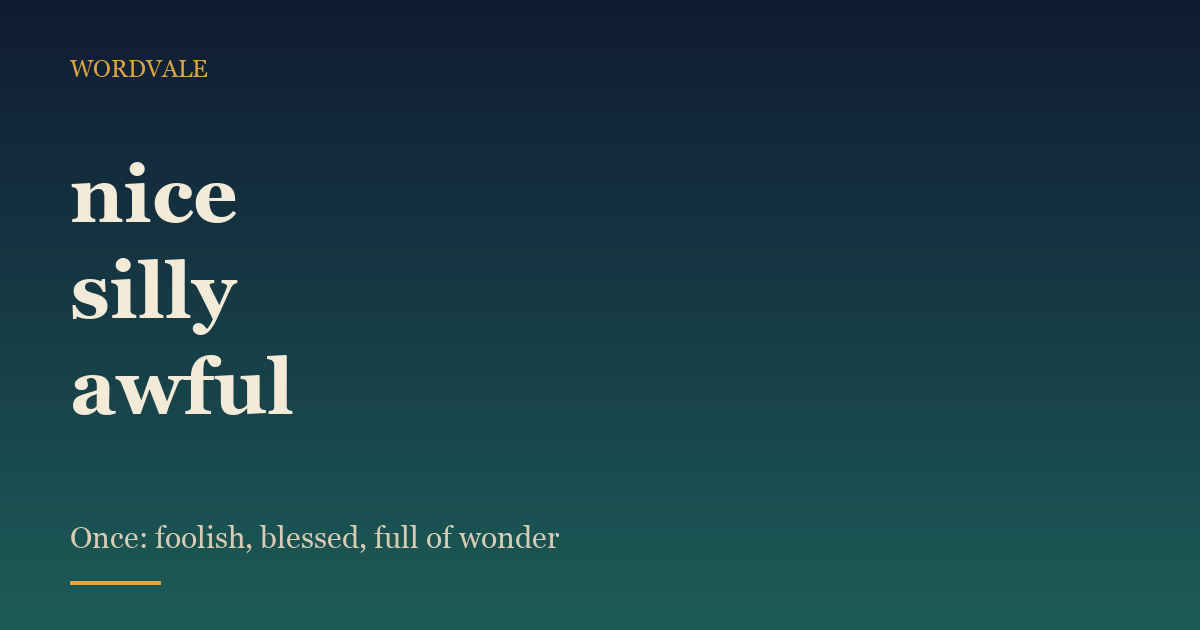
Every word in a dictionary is a snapshot. Meanings move, sometimes slowly over centuries, sometimes within a lifetime, and some of the most ordinary English words have travelled a very long way. The journeys are not random, either: they follow a few recognisable patterns, and knowing them makes older English much easier to read.
Nice: from ignorant to pleasant
Nice comes through Old French from Latin nescius, "not knowing", built from ne- (not) and scire (to know). When it entered English in the Middle Ages it meant foolish or simple. Over the following centuries it drifted through a series of senses, including fussy, dainty, and precise or careful, before settling on "pleasant" around the eighteenth century.
The "precise" sense has not died. A nice distinction is a fine or subtle one, not a pleasant one, and nicety still means a small detail. Readers of Jane Austen will find Northanger Abbey (1817) poking fun at the newer meaning: one character teases the heroine for using nice to praise everything, which tells you the "pleasant" sense was already being overused two hundred years ago.
Silly: from blessed to foolish
Silly began as Old English sælig, meaning happy, fortunate or blessed. Its German cousin, selig, still means blessed or blissful. In English, the word slid step by step: blessed, then innocent, then harmless and deserving of pity, then feeble, and finally, by the late sixteenth century, foolish.
Each step is small and easy to follow. Someone innocent is easily taken advantage of; someone easily taken advantage of looks simple; someone simple looks foolish. That chain of small, reasonable shifts is how most dramatic changes happen.
Awful and awesome: one went down, one went up
Awful originally meant "full of awe": inspiring wonder, reverence or fear. God could be described as awful in a perfectly respectful sense. By the nineteenth century, the word had weakened into a general intensifier and then into simply "very bad".
Awesome began in almost the same place and for a long time meant much the same thing: overwhelming, awe-inspiring. In the late twentieth century, especially in American English, it went the opposite way and became a casual word of approval. Two words from the same root, one now meaning terrible and one meaning great.
Decimate: from one in ten to almost all
Latin decimare described a punishment used, rarely, in the Roman army: a unit judged guilty of mutiny or cowardice was divided into groups of ten, and one soldier in each group was killed. The word comes from decimus, "tenth".
In English, decimate has been used for centuries in the looser sense of destroying a large part of something: "the disease decimated the population". Some style guides still object to this, arguing it should only mean "reduce by a tenth". In practice, the looser meaning is the one you'll read almost everywhere, and the one dictionaries treat as standard. If you want to be exact about a proportion, it's clearer to say the number.
Egregious: from outstanding to outrageous
Egregious comes from Latin egregius, literally "standing out from the flock": e- (out of) plus grex, gregis (flock, herd), the same root you see in gregarious and congregate. In English it first meant distinguished or excellent, a compliment.
From the late sixteenth century it began to be used of things that stood out for being bad, and that sense took over completely. It is usually explained as ironic use hardening into the normal meaning. Today an egregious error is a shocking one, and nobody would take the word as praise.
Literally: the argument that isn't new
Literally means "in the literal sense, exactly as stated". It is also widely used as an intensifier, for things that are not literally true at all: "I literally died of embarrassment." This use annoys a lot of people, and it is also much older than most of them assume. Mark Twain wrote in The Adventures of Tom Sawyer (1876) that Tom was "literally rolling in wealth", and nineteenth-century writers used it the same way.
Major dictionaries now record the intensifying sense, usually with a note that it is informal and criticised. The practical advice for learners is simple: understand both meanings, and in formal writing, use it only when you mean it literally.
Words that got narrower
Some words did not change direction so much as shrink.
- Meat once meant food of any kind. The old sense survives in sweetmeat (a sweet, not meat) and in the phrase meat and drink.
- Deer, Old English dēor, meant any wild animal. German Tier, "animal", is the same word.
- Girl in Middle English could mean a young person of either sex.
- Starve, Old English steorfan, meant simply to die, by any cause. German sterben still means to die.
Words that went up or down in the world
Linguists call a shift toward a worse meaning pejoration, and a shift toward a better one amelioration. Both are common.
- Naughty first meant having nothing (from naught), so poor or needy. It then came to mean wicked, and finally softened into the mild misbehaviour of children.
- Sad, Old English sæd, meant full or satisfied, then steady and serious, and only later sorrowful.
- Nervous could once mean sinewy or vigorous (related to nerve in its old sense of sinew), long before it meant anxious.
- Terrific meant terrifying, causing terror. Its modern sense of "excellent" came much later.
- Clue is a respelling of clew, a ball of thread. The thread Theseus unwound to find his way out of the Labyrinth made a clew the thing that leads you to an answer.
Why this matters when you read
Most of the time, a word's history is a curiosity. It becomes practical when you read anything more than a century or so old, because the older meaning can be sitting right there on the page and the sentence still makes sense with the modern one. A "nice" character in an older novel might be fussy rather than pleasant. An "awful" silence might be solemn rather than unpleasant. A "silly" shepherd in a sixteenth-century poem may be innocent rather than foolish.
A few habits help:
- When a familiar word feels slightly off in an older text, check a dictionary that lists older senses. The oddness is usually the clue.
- Learn surviving fossils such as a nice distinction, sweetmeat and meat and drink. They are small windows into the older meaning.
- Keep the word with its sentence. A word's meaning in a particular book is fixed by its context, so save the passage, not just the word.
English will keep doing this. Some of the words you learn this year will mean something slightly different in fifty years, and that is part of what makes vocabulary worth paying attention to. Here is a routine for keeping the words you meet.